

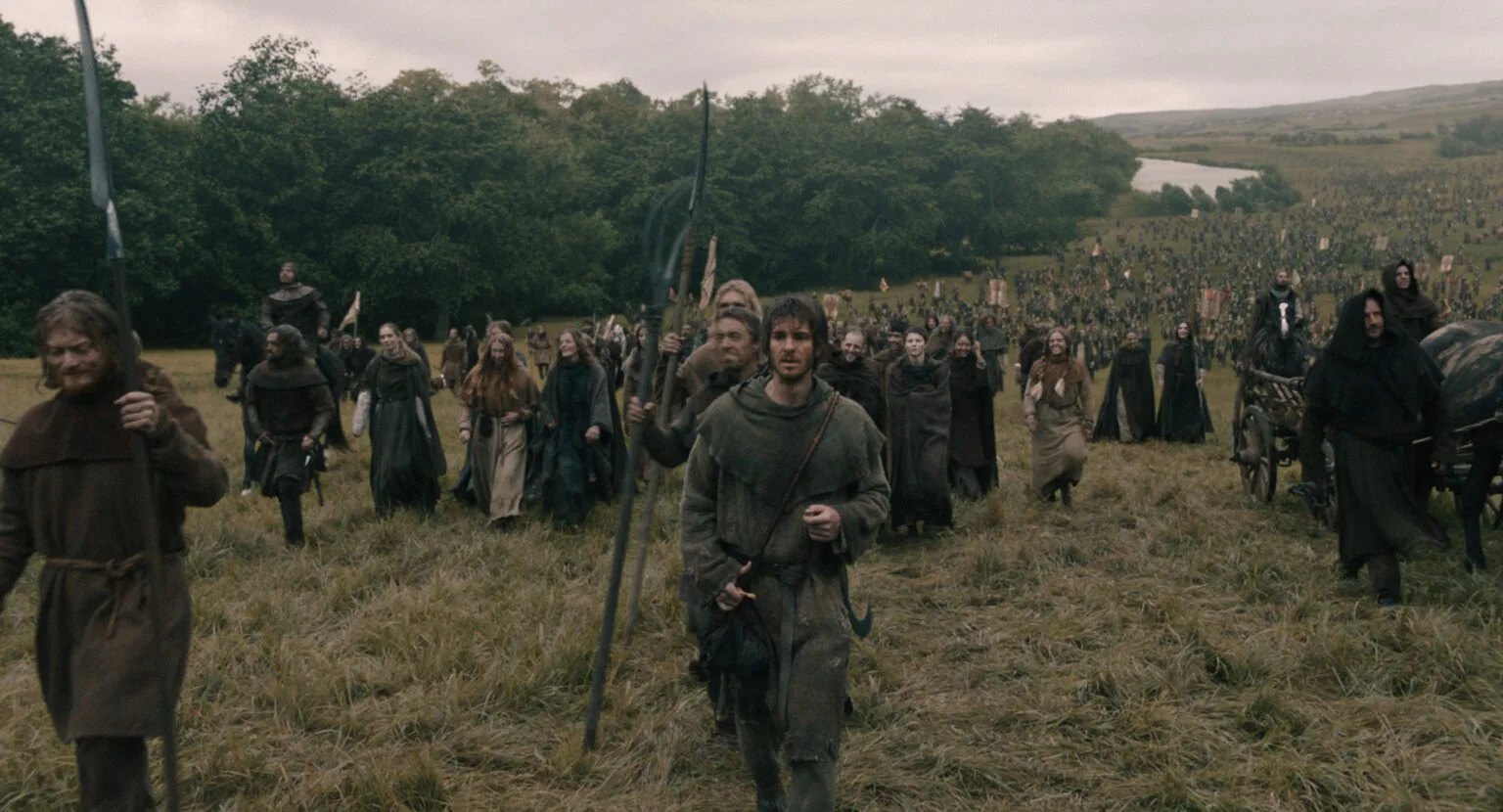
The Uprising
Bruce Steele: British filmmaker Paul Greengrass is usually such a contemporary director — United 93 (2006), three Jason Bourne movies, 22 July (2018) — that he seemed an odd match to the subject of a peasant revolt in 14th century England. Now that you've seen The Uprising, how would you rate Greengrass as a historical storyteller?
Edwin Arnaudin: He’s so successful at it that I’m surprised he hadn’t attempted one earlier. The closest he’d come to a period piece is his 2002 breakout Bloody Sunday, about the titular, tragic 1972 Irish protest march, and while his docudrama style seems best suited to modern tales, it’s an excellent fit here as well.
Greengrass’ polarizing handheld camerawork, zooms, and plentiful cuts amplify the tension surrounding the widowed Ploughman (Andrew Garfield), who decides he’s had enough of the Crown’s excessive taxation and other tyrannical ways and fights back, quickly finding he’s not alone in his stance. Were you similarly impressed by the fusion of style and substance?
Bruce: I was. Starting with The Bourne Ultimatum (2007) and especially Captain Phillips (2013), Greengrass developed a more-balanced blending of his docudrama flourishes and more traditional filmmaking, with longer shots (though often handheld) and expressive closeups, and this may be his most seamless synthesis yet. The style seems perfectly matched to the material — Greengrass also wrote the script — which online sources suggest is a fairly faithful account of the 1381 incident known as the Great Uprising. Greengrass's ability to keep viewers in the midst of the action surrounds us with the chaos that Ploughman and his allies both aroused and suffered from, as well as taking us inside the royal court, where a teenage Richard II (Woody Norman, C'mon, C'mon) is ill-served by a scheming council led by Treasurer Hales (Tom Hollander, who played Truman Capote in FX's Feud).
Both the king's council and Ploughman's cohorts are peopled with memorable characters, most of them (Ploughman excepted) with historical counterparts. Who stood out for you?
Edwin: Jamie Bell’s John Ball is the obvious pick. Labeled a “heretic,” this priest is essentially the prototype for free-thinking, 20th-century preachers willing to break with the church and align with just causes such as the Civil Rights movement. As his platonic female counterpart, Thomasin McKenzie (Jojo Rabbit) gives a fiery turn as Alyce, whose quasi-bloodthirsty mindset startles Ploughman but finds backing from Ball.
Much of the royal court feels a bit cliché — greedy old men doing whatever they can to stay in power — yet necessary to the plot. But I found Katherine Waterston (Inherent Vice) quite moving as the King’s concerned, protective mother and was oddly terrified by Jonny Lee Miller's portrayal of London Mayor Walworth. I didn’t think Sick Boy had it in him to be so vile!
Bruce: I agree across the board, although I always enjoy Hollander's portrayals of devious privilege. Our hero, Ploughman, remains a rather stock "good man roused to anger" for most of the film, until the horrific events inside the city of London, and a final betrayal, finally allow Garfield to inject some nuance into his performance. Similarly, Norman's King Richard is passive and frightened for much of the movie, then takes an unexpected turn (which the historical king apparently really did). And while I liked the idea of a royal scribe aligning himself with Ploughman to facilitate a settlement with the king, the sympathetic actor Sky Yang is the one character who seems too 21st century to fit the film.
Of course, the 21st-century echoes in the film are readily apparent, as the mob goes all January 6 on the government. What was your interpretation of Greengrass's message to modern viewers?
Edwin: For much of the runtime, my internal “blurb” review was, “Proto-Jan. 6, except not misguided/insane.” But there are also instances when the citizenry are walking to London, peacefully sharing unifying folk songs that reminded me of Civil Rights movement marchers singing “We Shall Overcome.” This detail suggests that music can indeed bring people together over a just cause — and I do believe that the motivations here are worthy. These people are struggling to survive and the current system is not working for them — reminiscent of an even more extreme situation that faced American Colonists in the 1770s.
The de facto leaders of this revolt aren’t afraid to use force when necessary, but Ploughman chooses mercy whenever possible — including a pivotal encounter with Waterston’s Countess — and the mob’s goal of an audience with the King to air their grievances is reasonable (if, ultimately, naive). Nevertheless, the early ransacking of a cathedral suggests that this may not be the most organized or level-headed movement.
When things don’t go as planned and violent instincts win out, Greengrass’ message gets a tad muddled. Unlike the Jan. 6 insurrectionists — who showed up to Washington with weapons, hand-ties, and even gallows and nooses, clearly out for blood in the name of a lost cause — this variously armed group comes across as simply a very large contingent with a shared righteous goal but two very divergent viewpoints on how to get there. An epilogue suggests that Greengrass’s overarching theme is perseverance in the face of tyranny, but it’s tough to tell how much the filmmaker is sticking to the historical record and where he’s layering in contemporary viewpoints.
Bruce: I loved the epilogue, you're right — it tells us that while even a great mob may not be able to change the world, individuals can make a difference in their own way. Yes, the rebellion is burdened, as you point out, by the irresolvable tension between principled protest and unhinged anger — but so is almost every social movement, political party, and governing body. The Uprising argues that while this handicap precludes massive reformation in a short time, lesser victories are possible and important.
That may not be a message audiences can rally behind, and the movie isn't doing so well at the box office. That's a shame, because it's an incredible, largely true story told by a master storyteller with all the period details you could want: great costumes and sets, realistic locations, and lots of Game of Thrones-worthy CG citiscapes and drone shots. I recommend it highly and give it an A-minus.
Edwin: Folks truly are missing out by not seeing The Uprising. After a string of movies that have been innocuous (The Lost Bus), solid but puzzling (July 22), and downright bad (News of the World), Greengrass returns to form with his best work since Jason Bourne (2016). It’s timely, entertaining, well-made, and educational — all qualities that viewers claim to value. If the shoddy and extremely obvious Nuremberg can light a fire under armchair activists, this film might actually push them into action. It gets a solid B-plus from me.
Overall grade: A-minus. Rated R. Now playing at AMC River Hills 10, Carolina Cinemark, and Regal Biltmore Grande.
(Photo: Focus Features)