
Wildwood
Bruce Steele: To talk about the new stop-motion animated feature Wildwood, I'm joined by animator Christopher Oakley. In addition to being my husband, Christopher is an animator whose first professional job in the business was with Will VInton Studios, as a stop-motion assistant animator in the mid 1980s. More than a decade after Christopher's time with Vinton, the Oscar-winning animator and director was forced out of his own studio, in part by Travis Knight, an animator whose father is Phil Knight, the owner of Nike — and now the owner of the studio. In 2005, Laika became the company's new name. Previous to releasing Wildwood, Laika had produced five features, beginning with Coraline (2009), all of which have been nominated for the Academy Award for Best Animated Feature, although none has won. Christopher, meanwhile, transitioned from stop-motion animation to computer animation in the mid 1990s and went on to work for Disney, DreamWorks, EA Games, and other companies before joining the New Media faculty at UNC Asheville, where he now teaches animation.
So, let's get to the movie. Wildwood is quite a milestone, certainly the most ambitious stop-motion feature ever made (as well as the longest, at just over two hours). It's been in development at Laika for 15 years and in active production for about five. The plot very closely follows its source material, a middle-grades fantasy novel of the same name by married creators Colin Meloy (text) and Caron Ellis (illustrations), published in 2011. It's a natural for Laika, not only because it's overflowing with talking animals, magical creatures, and fantastic events, but also because it's set partly in Portland, Oregon, where Will Vinton Studios was located and where Laika is still based. So, Christopher, what happens in this story and what were your initial impressions?
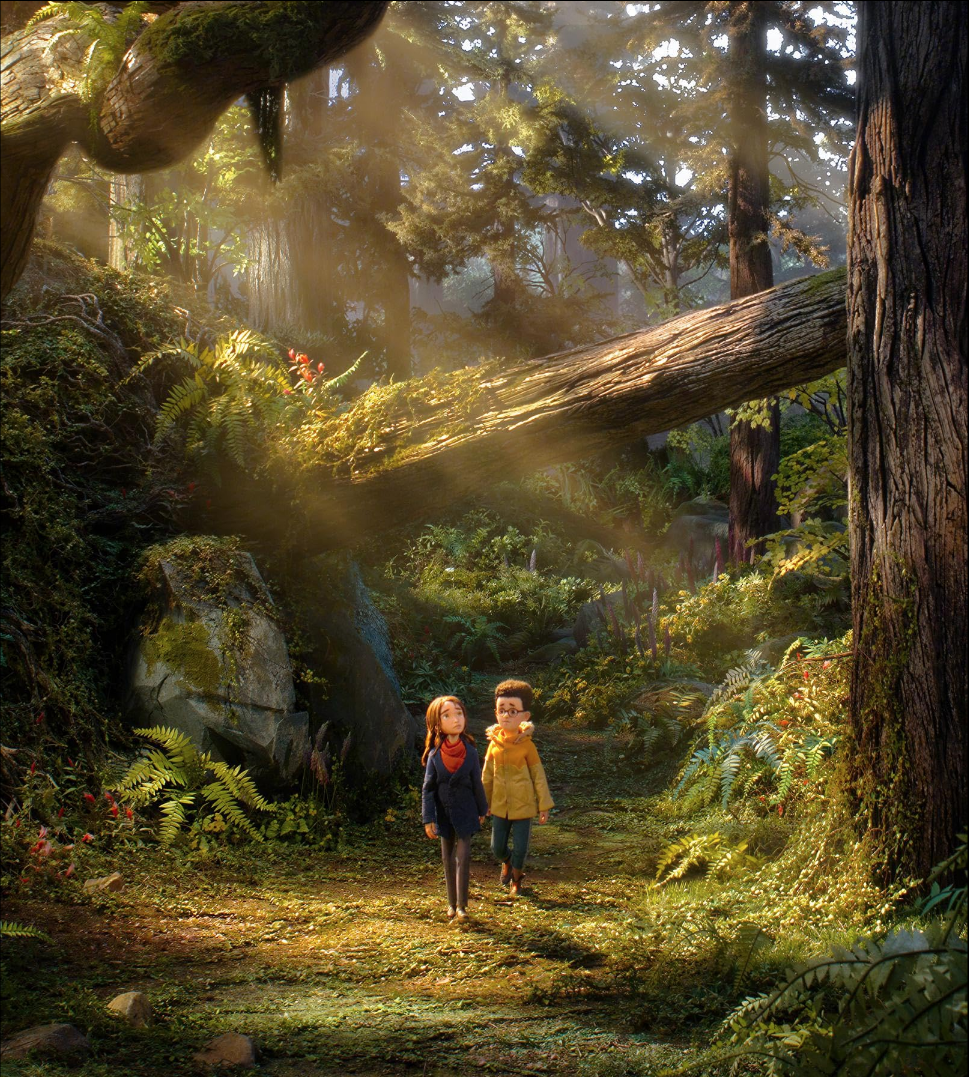
Christopher Oakley: The story is quite breathtaking in its epic scope. We follow a young teen, Prue McKeel (voiced by Peyton Elizabeth Lee), who must venture into the enchanted but forbidden "Impassable Wilderness" in search of her baby brother, Mac, who was abducted by a murder of crows. Prue's homespun hippie parents, stereotypical Portland health-nut "hippies," had forbidden Prue to leave the house with Mac, owing to something dark and mysterious lurking in the shadows of the city, and in their past.
Prue is joined on her journey by another teen, Curtis (voiced by Jacob Tremblay), who is hopelessly a nerd in every sense. As they search for Mac, they are met by a menagerie of talking animals, including an army of uniformed coyotes who are the henchdogs of the story's villain, Alexandra, an enchantress (voiced by Carey Mulligan). They also meet up with a community of bandits, birds of every feather, seemingly incompetent mystics, farmers, a postman, and a hilarious rat named Septima (superbly voiced by Awkwafina).
It's so much to take in — and that may be the core of my problem with the film. When making an animated film, not a frame gets animated until the script and storyboards are locked, both in shots and length. It seemed to me that several scenes would have benefited from pre-animation trimming. The families sitting next to us in the movie theater actually got up and left right after the climax of the film, but well before the ending. Did you feel the same way?
Bruce: It is too long, and it's easy to point out individual scenes and plot threads that should have been eliminated or pared way back. I get the feeling that Travis Knight, the director, didn't want to cut anything his team had animated — but you're right, the excess should have been pared away before animation.
But I don't want to sound too negative — what's there looks amazing, the story is engaging, and there are a lot of fun characters to enjoy. Adults and older children who enjoy animated features will be entertained and often awestruck, although I think it's too long and too dark for younger children. Knight is clearly aiming finally to win that Animated Feature Oscar through sheer ambition, and the artistry is there. Were you impressed with the animation?
Christopher: I did feel the animation was practically flawless and jaw-droppingly exquisite in its execution. And I agree that it seemed to me to be a very adult film in themes and story. The opening sequence, featuring a suicide (of sorts), was disturbing and uncomfortable on many levels. I kept waiting for the public service announcement reminding viewers of the hotline to call. Given the non-stop conversation the nearby family was having in the theater throughout the entire film, it was clear that the children were not engaged.
But back to the animation. Unlike previous Laika films, this one is especially packed with computer animation and sets. It's blended so well with the stop-motion puppet animation and sets and camera work that it becomes difficult to see where one picks up where the other leaves off. Did the blending of techniques work for you?
Bruce: It looked great, and often you can't tell where the puppet animation stops and the CG effects begin. But I also thought that drained away some of the appeal of a stop-motion film, which is the sense of physicality, of solid objects moving in space, of artistry that still bears the fingerprints — in clay animation, literally — of the artists who worked on it. Which brings me to another question I have for you, since you've worked professionally in clay animation, stop-motion puppets, and CG: Was stop-motion the best choice to tell this story?
Christopher: As it happens, the same question was posed to me by Will Vinton himself 40 years ago. We were having lunch one day and we were discussing my desire to make a stop motion short film of Lincoln delivering the Gettysburg Address. Will asked, "Why animation? Why not make it a live-action film?" I responded that I felt animating it would make it more appealing to younger viewers. Will's response was, "The only reason to do it in animation is because there's no other way to do it." Since that conversation, I evaluate every piece of animation I see through that lens.
With all the anthropomorphized characters from the animal kingdom populating the Impassible Forest, Wildwood's story certainly lends itself to animation. But did it need to be stop-motion animation? Certainly not. While I wish the stop-motion was more readily apparent throughout the entire film, I also realize the battle scenes would have been impossible to pull off that way. So I'm left a bit disappointed — especially as a stop-motion animator. What are your final thoughts?
Bruce: I don't want everyone thinking we hated this movie. There's tons of talent on display here, from the animators, the fabricators, the costumers, the set builders — amazing sets! — the visual effects crew, and more. The storytelling is loose but often thrilling, and the voice cast is excellent. Awkwafina is the standout, and in addition to those already mentioned, there's Richard E. Grant as a noble owl, Len Cariou as the Postmaster, Angela Bassett as the General (a giant hawk), Mahershala Ali as a rebel leader, and Blythe Danner in a cameo as an old seer... to mention a few. Despite the movie's flaws, I'd still recommend it to all animation fans and anyone else who's curious. I give it a solid B. What about you?
Christopher: Yes, to say a film could have been better in a few select ways is not to hate on it. The overall look of the film, the animation, the variety of characters, the complexity of the puppets — especially the birds — was awe-inspiring. Laika typically focuses their energies on achieving the highest in stop-motion artistry. I just wish they had someone onboard focusing more on storytelling. If it were 20 minutes shorter, I'd give it far more than my solid B.
Grade: B. Rated PG-13. Now playing at AMC River Hills 10, Asheville Pizza and Brewing, Carolina Cinemark, and Regal Biltmore Grande.
(Photo: Fathom Entertainment)