
undertone
For this review, Asheviille Movies contributor Bruce Steele is in conversation with his husband, Christopher Oakley, who's an experienced ghost-hunting enthusiast.
Bruce: The new thriller undertone (all lowercase, please) is being marketing as "the scariest movie you'll ever hear." The premise of this first feature from writer/director Ian Tuason is simple: Our heroine, Evy (Nina Kiri), co-hosts a "true haunts" podcast with her friend Justin (voiced by Adam DiMarco), who lives six time zones away in London. They tape the show at 3 a.m. Evy's time, perhaps because Evy's home studio is temporarily set up in her mother's creepy old house, while Evy is caring for her dying and mostly comatose Mama (Michèle Duquet).
For the latest episode of their podcast, Justin shares 10 increasingly disturbing audio files of unknown origin (or veracity). Inspired by the audio files' contents, Evy goes down some internet rabbit holes about the dark side of children's songs and a malevolent mythological figure or two, and there's a Blair Witch Project sense of inescapable doom threading through.
That's about it. The film never leaves the house, and the scares are predominantly aural.
Christopher, you know this stuff better than I do, since you do ghost hunts and seek out spirit voices via EVPs — electronic voice phenomena, which can be heard only on recordings. That said, I have two questions to start: How does the creepy sound design of this film match or diverge from your own experience? And, more to the point, were you scared?
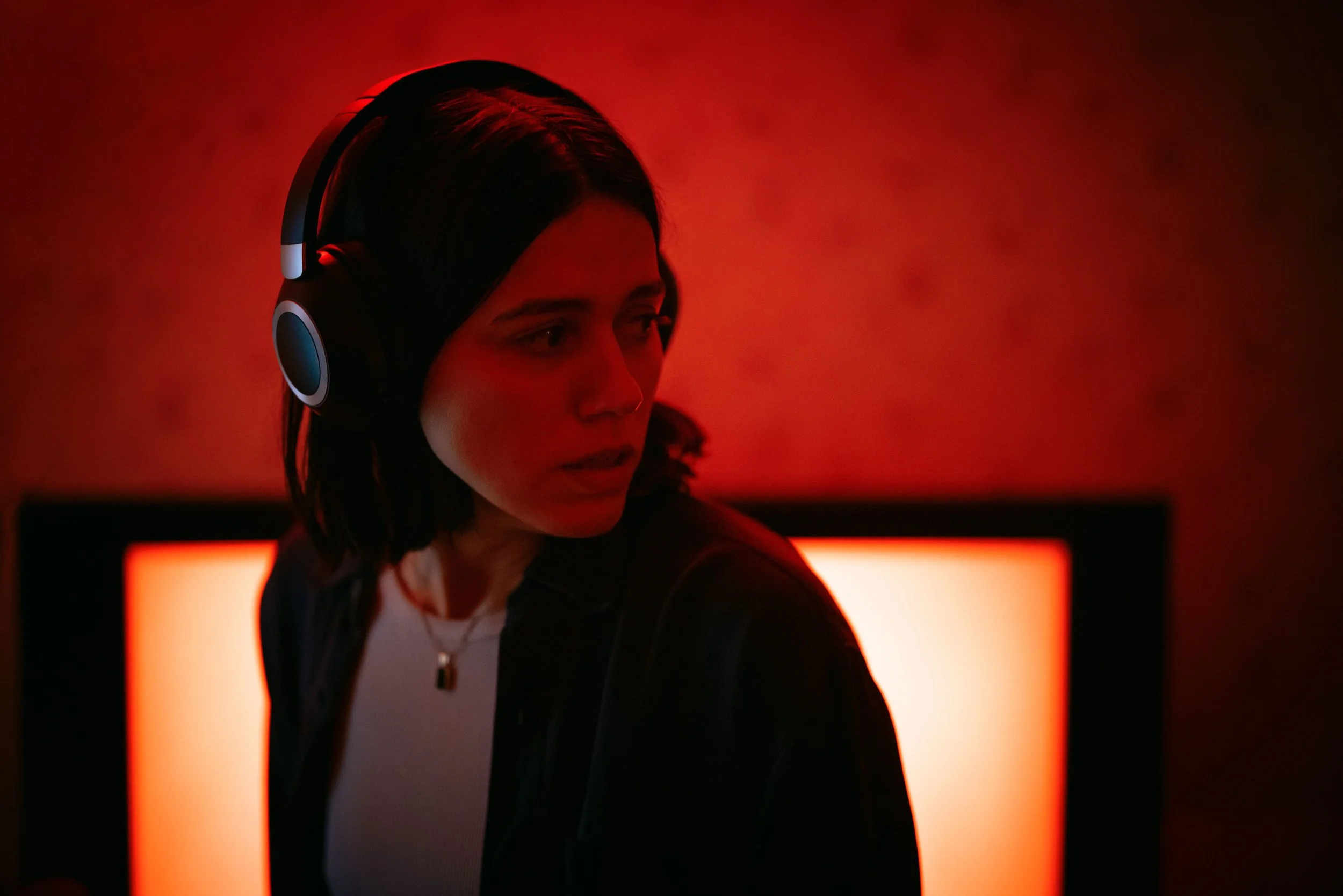
Christopher: One of the things undertone got absolutely right was that moment of dread you feel as a ghost hunter when you put on the noise-cancelling headphones to review creepy EVP sessions or (in the case of the movie) anonymous and ominous recordings. Whether you're watching for anomalies in an audio waveform as you listen for disembodied voices or fearing for Evy as she listens in complete isolation to the recordings during her podcast, the listener can't help but be immersed in the events of the recording. As they discovered in radio broadcasts in the 1930s and ’40s, what you imagine when locked into that audio world is far scarier than anything they could film.
Bruce: I do wonder whether Evy was named after “EVP.” For readers unfamiliar with that concept, can you explain a bit?
Christopher: As documented on countless ghost-hunting TV shows, during a typical EVP session, questions are asked of unseen spirits that may be present. While you usually hear no response in real time, when you play the recording back, you can sometimes hear voices that are otherworldly and responsive to the questions. Quite often, these responses are unexpected and chilling. Sometimes they're even malevolent. The best EVP I ever personally captured was immediately after investigating a cemetery in Gettysburg for three hours. A voice on the recording said, "I forgive you for walking over my grave."
Bruce: And how does the movie use that kind of creepy aural experience to scare the audience?
Christopher: By promising the viewer/listener that each recording will be scarier and more dangerous to listen to than the preceding one, undertone takes that fear of a surround-sound audio jump scare to new heights. The audio files begin with an unidentified man and a woman recording themselves in fairly mundane circumstances but quickly escalate to the Top 40 greatest hits of our deepest fears. Each subsequent audio recording and nursery rhyme played backwards reveals how much more terrifying this previously unseen, or unheard, world can be — far exceeding what one normally hears during a typical EVP session.
I've never been a fan of jump scares in films, even though they're usually telegraphed far in advance. Normally I look away from the screen when I know a jump scare is coming. But there is no sugarcoating the chill that runs down your spine when an unexpected sound or voice suddenly shatters your perception of a safe and secure world — and it is nearly impossible to tune out undertone's creepy, richly designed soundtrack as it careens recording by recording toward its crescendo.
Bruce: I’ll admit that the movie was generally creepy, but I think “careens” is the right word for the plot, since rather than building a coherent narrative by putting the different pieces together, it just gets louder and more insistent, with more rapid-fire editing. It never made any sense to me. I never really knew what was happening, what the filmmaker was trying to tell us was happening, or what all the fragments of stories — some from the audio files, some from myths, some from hearsay provided in the final third of the film by random, unreliable callers who were listening to the live broadcast — had to do with one another. Did it all make more sense to you?
Christopher: I’ll agree that the callers seemed like an easy out for the film, bringing in information that the two main characters could easily have found on a Google search of their own during their broadcast. While it underscored the community nature of podcasts and social media, it seemed tacked on here.
In general, though, I was fully buckled in for the ride and didn’t feel like I had to put the pieces together. I felt each recording and each shot advanced the story, albeit sometimes too slowly or repetitively.
I found it interesting that the director chose to move Evy to different locations in the house for each broadcast. And also that in each location she was facing the wrong way to see any danger that might emerge. Any two-bit gangster knows to sit with your back to the wall so that you can see who is approaching. It made me think of Audrey Hepburn in Wait Until Dark (1967) or films like that. Evy was so vulnerable, even though she doesn’t quite realize it for much of the film.
Did you think Evy taking care of her dying mother at the same time these recordings arrived was coincidence or were they somehow linked?
Bruce: Clearly there’s supposed to be a narrative link between the dying mother and the supernatural sounds and the mythological fragments, but the connections eluded me. Does the mother’s spirit, approaching the realm beyond death, trigger the events Evy experiences? That makes some sense, I guess, but it would have been nice if the filmmaker would have clarified that — or indeed anything else. Overall, I think undertone creates a mood, a building sense of dread, and utterly fails to tether its atmosphere or its admirable sound design to any comprehendible storytelling. Then it ends, very abruptly. I give it a D.
Christopher: I see what you mean, but I think I was so wrapped up Evy’s escalating peril that I let those failings slip by mostly unnoted. For me, long shots of Evy sitting in isolation with two thirds of the screen focused on empty spaces in the house, from which anything could emerge, paired nicely with the unsettling sounds coming from the audio. It certainly made an impression on me, and I’ll be thinking about this film every time I put on noise-cancelling headphones to analyze and catalogue EVP sessions from now on. I give it a B-plus.
Overall grade: C-plus. Rated R. Now playing at the AMC River Hills, Cinemark Bistro at the Carolina Asheville, and Regal Biltmore Grande.
(Photo: A24)